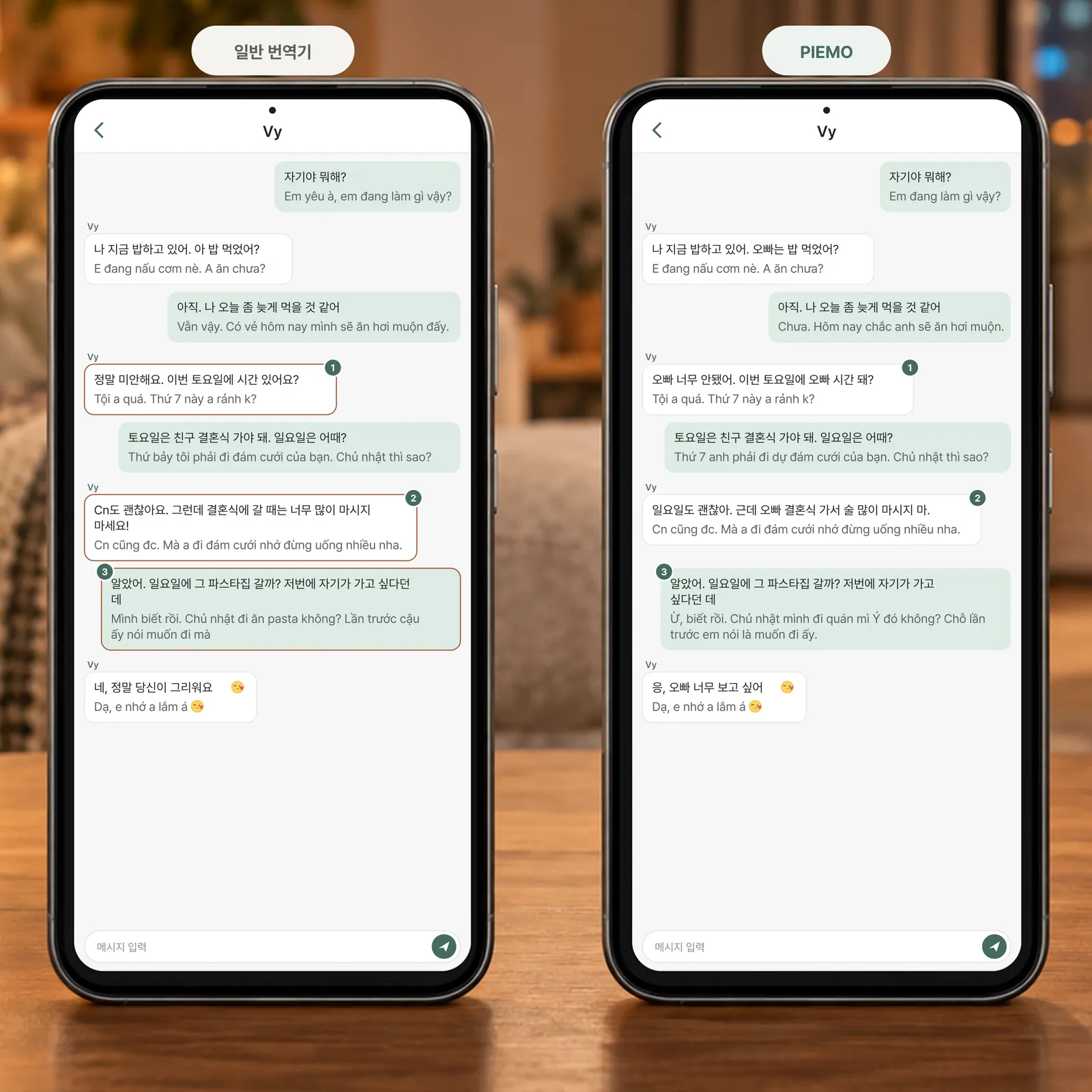
Write in your own language, read in your own language.
Ordinary translators look at one sentence at a time, so they often miss who is being talked about and who is addressing whom. Piemo translates with the earlier conversation and the relationship between the two people in mind, so families and couples who speak different languages get both the meaning and the tone across.
Invited people just enter a name, a form of address and a language to join.
Same conversation, different translations
Good translation needs nuance and the whole conversation
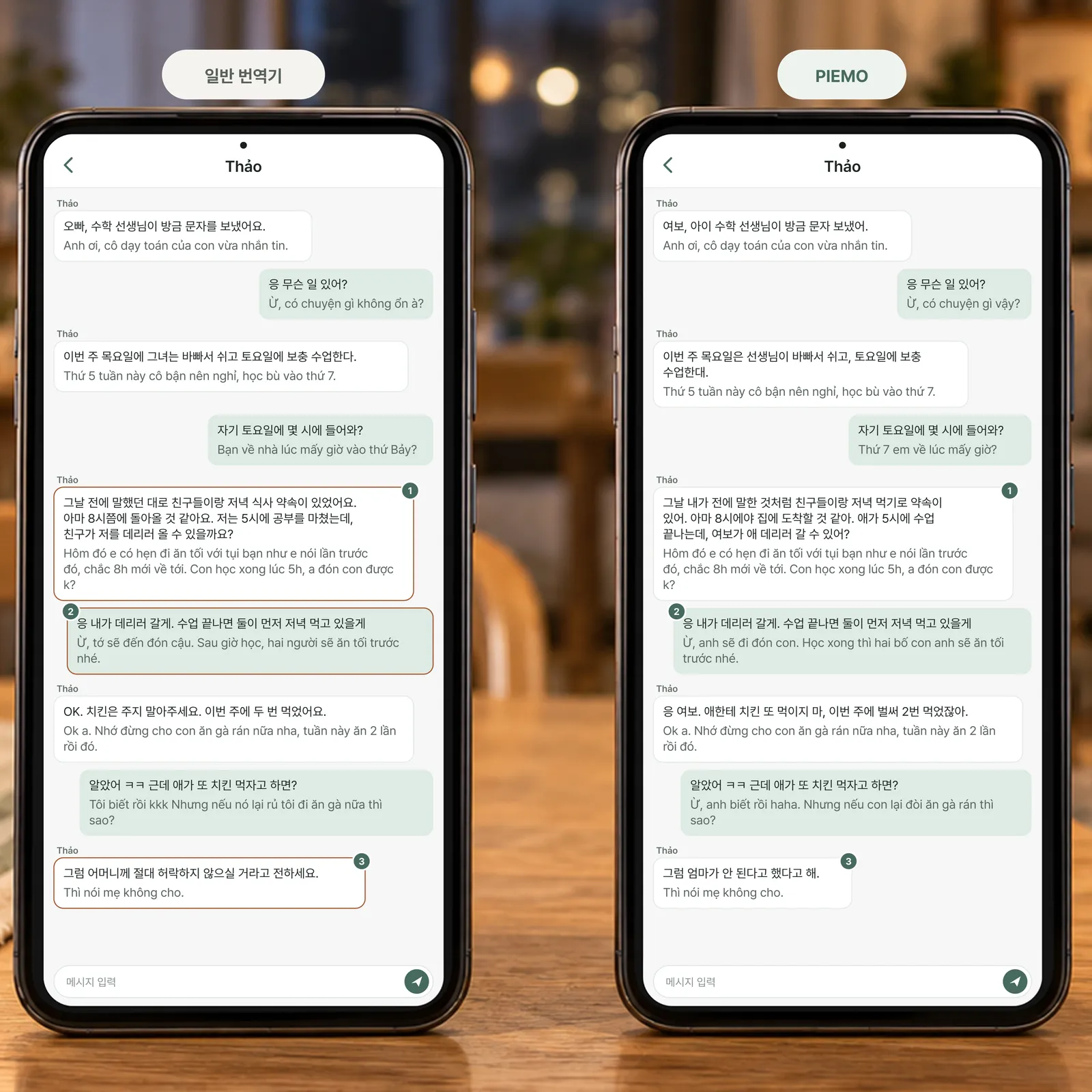
This is the Korean speaker's phone. Each bubble shows what the other person actually wrote together with its translation. Below, every message and result is explained in English so you can compare.
What it meansYeah, I'll pick the kid up. After class, the two of us will have dinner first.
Ordinary translator
Ừ, tớ sẽ đến đón cậu. Sau giờ học, hai người sẽ ăn tối trước nhé.
The translation saysYeah, I'll come pick you up. After class, the two people will eat dinner first.
Now he's picking up his wife instead of the child.
Piemo
Ừ, anh sẽ đi đón con. Học xong thì hai bố con anh sẽ ăn tối trước nhé.
The translation saysYeah, I'll go pick up our kid. After class, dad and the kid will have dinner first.
Knows from earlier that he's picking up the child, so “the two of us” becomes dad and child.
See messages 1 and 3
1Wife writes in Vietnamese
Hôm đó e có hẹn đi ăn tối với tụi bạn như e nói lần trước đó, chắc 8h mới về tới. Con học xong lúc 5h, a đón con được k?
What it meansThat day I have dinner plans with friends, like I told you. I'll probably be home around 8. The kid finishes at 5 — can you pick them up?
Ordinary translator
그날 전에 말했던 대로 친구들이랑 저녁 식사 약속이 있었어요. 아마 8시쯤에 돌아올 것 같아요. 저는 5시에 공부를 마쳤는데, 친구가 저를 데리러 올 수 있을까요?
The translation saysThat day I had dinner plans with friends as I said before. I'll probably be back around 8. I finished studying at 5 — could my friend come pick me up? (formal)
The child's schedule became the wife's own, and the husband became “a friend”.
Piemo
그날 내가 전에 말한 것처럼 친구들이랑 저녁 먹기로 약속이 있어. 아마 8시에야 집에 도착할 것 같아. 애가 5시에 수업 끝나는데, 여보가 애 데리러 갈 수 있어?
The translation saysThat day I have dinner plans with friends, like I said. I'll probably get home around 8. Our kid finishes class at 5 — honey, can you pick the kid up?
Tells apart e (me), a (you, husband) and con (child), so the request stays intact.
3Wife writes in Vietnamese
Thì nói mẹ không cho.
What it meansThen tell them mom says no.
Ordinary translator
그럼 어머니께 절대 허락하지 않으실 거라고 전하세요.
The translation saysThen please tell your mother that she will never allow it. (formal)
Took 'mẹ' — the child's mom, the speaker herself — as someone's mother.
Piemo
그럼 엄마가 안 된다고 했다고 해.
The translation saysThen say that mom said no.
Knows this is something to tell the child, so 'mẹ' is the child's mom.
Ordinary translator results are excerpts from entering each sentence into 3 free translation services (September 2026). Piemo results are the actual output of its translation engine. “The translation says” lines are English explanations of the Korean or Vietnamese translations.
Why Piemo
A translator alone doesn't carry a family's words across
Copy, translate, paste
Switching between a messenger and a translator app means long conversations get put off.
It doesn't know who is talking to whom
Without the relationship, warm words turn stiff and polite speech turns blunt.
You can't tell if it came across
If you only know one of the languages, there's no way to check the translation.
In any relationship
Forms of address and tone, translated for the relationship
Piemo translates knowing the relationship you chose when creating the room — in families, but also at school, at home and between friends.
Mother-in-law → daughter-in-law한국어 → Tiếng Việt
Daughter-in-law's screenCon ơi, lúc làm kim chi thì mẹ con mình làm cùng nhé. Mẹ sẽ chỉ cho con.얘야, 김치 담글 때 같이 하자. 내가 알려 줄게.
The mother-in-law becomes mẹ and the daughter-in-law con — the way Vietnamese families address each other
Parent → teacherTiếng Việt → 한국어
Teacher's screen선생님, 오늘 아이가 열이 조금 있어서 하루 쉬겠습니다.Thưa cô, hôm nay cháu hơi sốt nên xin cho cháu nghỉ một ngày ạ.
The polite ạ becomes Korean honorific speech
Tenant → landlordTiếng Việt → 한국어
Landlord's screen사장님, 저희 집 온수기가 고장 났는데 한번 봐 주실 수 있을까요?Chú ơi, máy nước nóng nhà cháu bị hỏng rồi, chú xem giúp cháu được không ạ?
A polite request to an elder, kept polite
FriendsTiếng Việt → 中文
Chinese friend's screen这周末一起去吃火锅吗?我知道车站附近有一家很好吃的店。Cuối tuần này mình đi ăn lẩu không? Mình biết một quán ngon gần ga.
No Korean needed — two languages translated directly
Many languages in one room
Language classes and multinational groups, in one room
A room can hold up to 9 languages and 50 people. A teacher's notice written in Korean appears in each student's language, and students can talk to each other in their own languages too.
Everyone reads in their own language — Each message is translated into every language in the room.
Languages are added as people join — When someone who speaks a new language joins by invite link, that language is added to the room automatically.
See how your words came across — Tap “N translations” under a message you sent to see every language's translation.
How it works
Three steps to start talking
1
Create a room
Choose your relationship with the other person, and translation uses the right forms of address and tone.
2
Invite by link or QR
Send the link via KakaoTalk or Zalo, or show the QR code. The other person just enters a name, a form of address and a language.
3
Chat in your own language
What you write appears in their language, and what they write appears in yours. You can send photos too.
Used forSpouses · Couples · In-laws · Family · Friends · Neighbors and landlords · Schools, daycare and language classes · Hospitals, offices and shops · Work
Translation quality
Built so you can check and fix
Translations can be wrong, so ways to notice and correct them live right inside the conversation.
Relationship-aware translation
For example, Vietnamese anh is rendered as the Korean word you picked (oppa, yeobo or jagi), with the right form of address and tone.
View the original
See what the other person actually wrote, right below the translation, any time.
Back-translation
Check how your words were translated, back in your own language, and fix them on the spot if they're off.
Fix translations
Someone who knows both languages can correct a translation; the original stays, and the fix shows with their name.
Custom words
Register words only your family knows, like a child's name or a neighborhood, and later translations get them right.
Report a translation
One tap sends that message and up to 10 messages before it to the team, used only to improve translation.
Translate only — Sit face to face and take turns on one phone.
Copy the translation — Send it straight to KakaoTalk or Zalo.
With photos — Send photos with a caption, view them large and save them.
New message notifications — Add it to your home screen and use it like an app.
Two languages can talk without Korean (for example Vietnamese and 中文), and one room can mix many languages. If a beta language gives an odd translation, report it from the message menu and we'll check and fix it.
Start for free
Up to 1,000500 sign-up bonus + 500 for agreeing to receive news and offers
200 a monthFree every month with an account
400 a monthIn a two-person room when both have accounts, combined
Bonuses can be used for 90 days from the day you receive them. If you talk a lot and need more, contact woomin@floatai.io.
FAQ
Frequently asked questions
What is Piemo?
A translated chat where family, couples, neighbors and groups who speak different languages each write and read in their own language in one room. It translates using the relationship chosen when the room was created and the earlier conversation, so forms of address and tone come across correctly.
Does the other person need to install an app or sign up?
No. They open the invite link or QR code and enter a name, a form of address and a language to join right away. It works in the phone's browser with no install, and can be added to the home screen to use like an app.
Which languages are supported?
Korean, Vietnamese (native-reviewed), Chinese, Japanese, Filipino, Thai, English, Khmer (beta) and Bengali (beta). Two languages without Korean can also talk to each other.
Can one room use several languages?
Yes. A room can hold up to 9 languages and 50 people. Each message is translated into every language in the room, so it works for language classes and multinational groups.
Is it free?
When you sign up you get up to 1,000 translations including bonuses, plus 200 free every month. If you need more, contact woomin@floatai.io.
What if a translation is wrong?
Check it with the original and back-translation, and anyone who knows both languages can fix the translation on the spot. When you report an odd translation, the team reviews it to improve quality.
Create your first room today
Create a room and send one link. The other person can reply right away in their own language.